Double-beta decay physics
In this section we take a look at the primary spectrum produced by the bxdecay0 package. The main documentation for this extension is available here. It aims to reproduce reasonable primary particles to be used as generator for double beta decay physics.
Primary electron properties
The main thing we can compare here are the properties of the primary electrons produced. The bxdecay0 package actually does not even produce the neutrinos emitted in e.g. \(2\nu\beta\beta\).


Different decay modes for the Ge76 decay.
Here \(2\nu\beta\beta\) is the two neutrino double beta decay as predicted by the Standard Model. \(0\nu\beta\beta\) is the neutrinoless double beta decay channel (assuming light majorana neutrino exchange) used for e.g. sensitivity estimates by experiments like LEGEND. More exotic physics like the Majoron-emitting neutrinoless double beta decay with SI=1 \(0\nu\beta\beta\_M1\) shows a distinctive continuous electron spectrum. Other exotic physics like the \(0\nu\beta\beta\_\lambda0\) is a decay mode driven by right-handed currents according to the lambda mechanism and shows a distinctive angular correlation.
Majoron-emitting decay modes
The summed energy spectrum of the two electrons in Majoron-emitting neutrinoless double beta decay depends on the spectral index \(n\): the spectrum scales as \((Q_{\beta\beta} - E)^n\), where \(E\) is the summed electron energy. A larger spectral index moves the spectrum to lower energies. For comparison, the spectral index of \(2\nu\beta\beta\) is \(n = 5\).
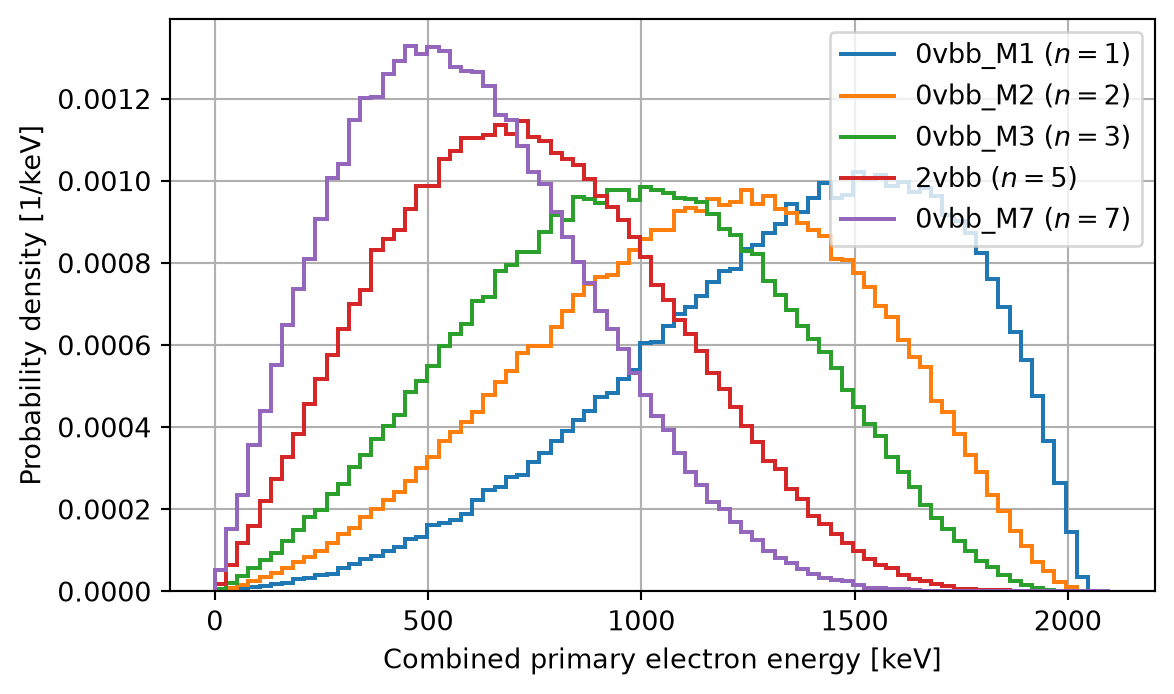
Summed energy of the two primary electrons for the Majoron-emitting decay modes of Ge76 with spectral index \(n = 1, 2, 3, 7\), and for \(2\nu\beta\beta\) (\(n = 5\)). Spectra are normalized to unit area. The test checks that the mean summed electron energy decreases with increasing spectral index.
Decays to excited states
Ge76 can also decay to excited states of the daughter nucleus Se76. The electrons then share at most \(Q_{\beta\beta} - E_\text{level}\), where \(Q_{\beta\beta} = 2039\) keV and \(E_\text{level}\) is the energy of the level. The daughter nucleus de-excites by emitting gammas:
\(2^+_1\) (559 keV): one gamma at 559 keV
\(0^+_1\) (1122 keV): two gammas at 563 and 559 keV
\(2^+_2\) (1216 keV): one gamma at 1216 keV, or two gammas at 657 and 559 keV
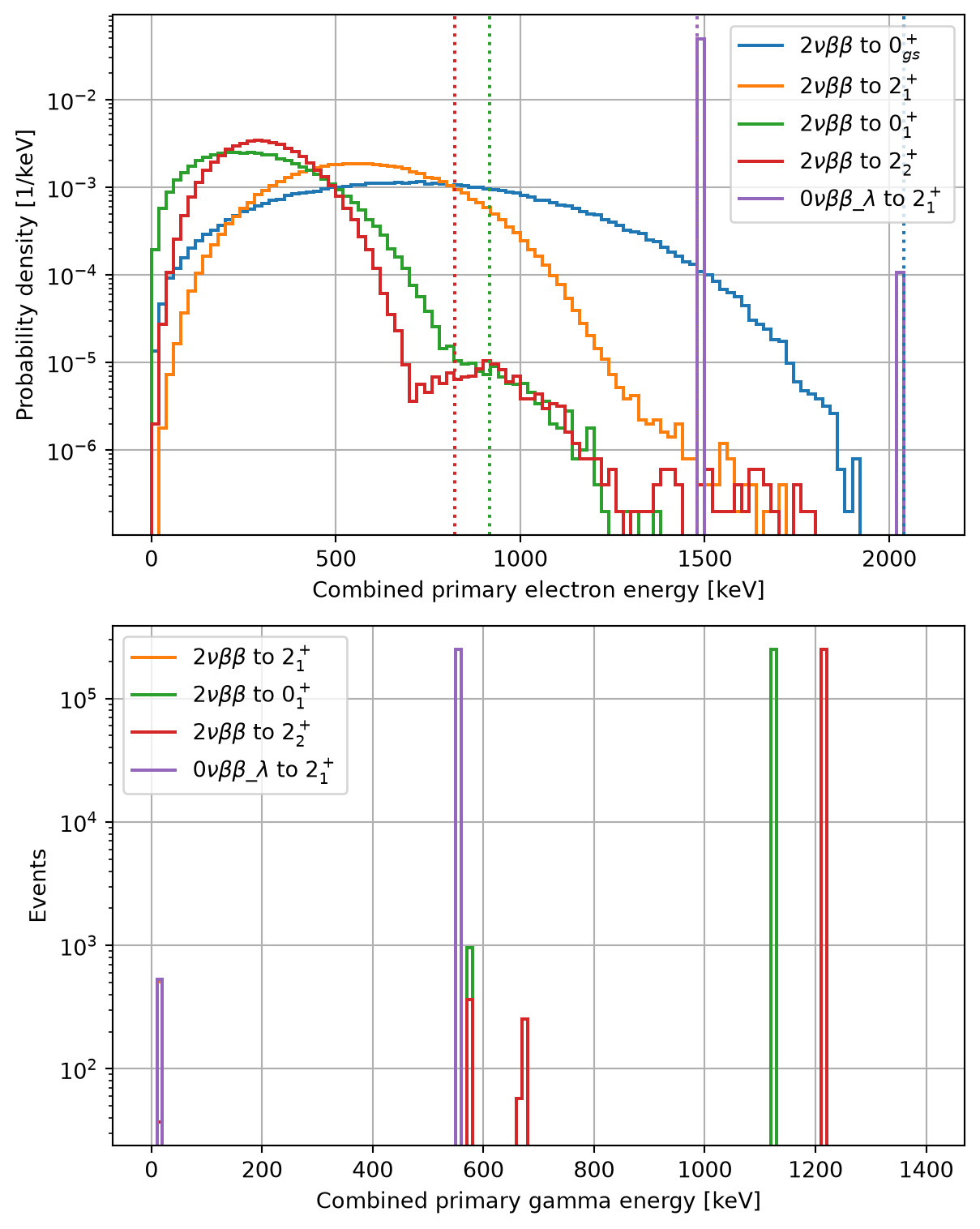
Top: summed energy of the primary electrons for the decays of Ge76 to the ground state and to the excited states of Se76. The dotted lines mark the endpoints \(Q_{\beta\beta} - E_\text{level}\). \(0\nu\beta\beta\_\lambda\) to \(2^+_1\) gives a single line at the endpoint. Bottom: summed energy of the primary gammas, which equals the energy of the excited level. The test checks the endpoints and the summed gamma energies.