Optical physics
In this section we compare the remage simulation output of optical processes with their theoretical expectations.
Scintillation emission
Different particles of varying kinetic energies are started in the center of a sphere of scintillating liquid argon. No attenuating optical processes are enabled. Cerenkov emission is disabled. The number and energy of the created photons is recorded.
For all particles, the same emission spectrum around a wavelength of 128 nm is expected. We do not expect the typical narrow liquid argon emission peak here, as for this validation we implemented a broad shape (step-function) as the emission spetctrum[1]. For each primary energy, a narrow peak of emitted photons is visible, varying with particle type.
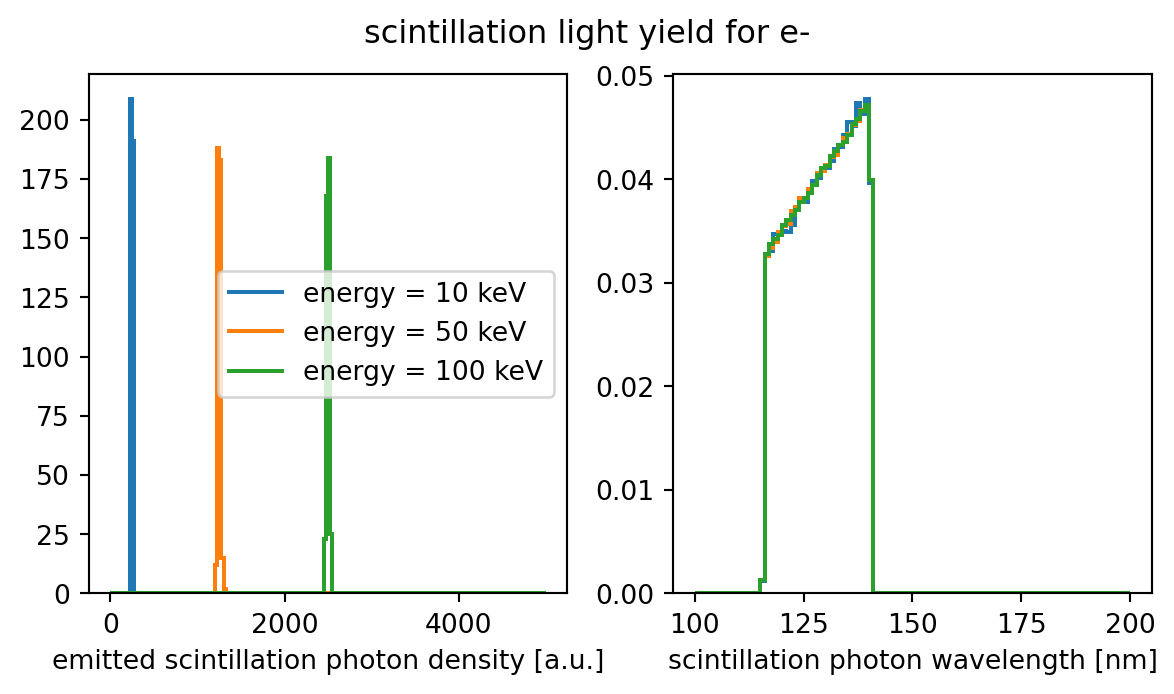
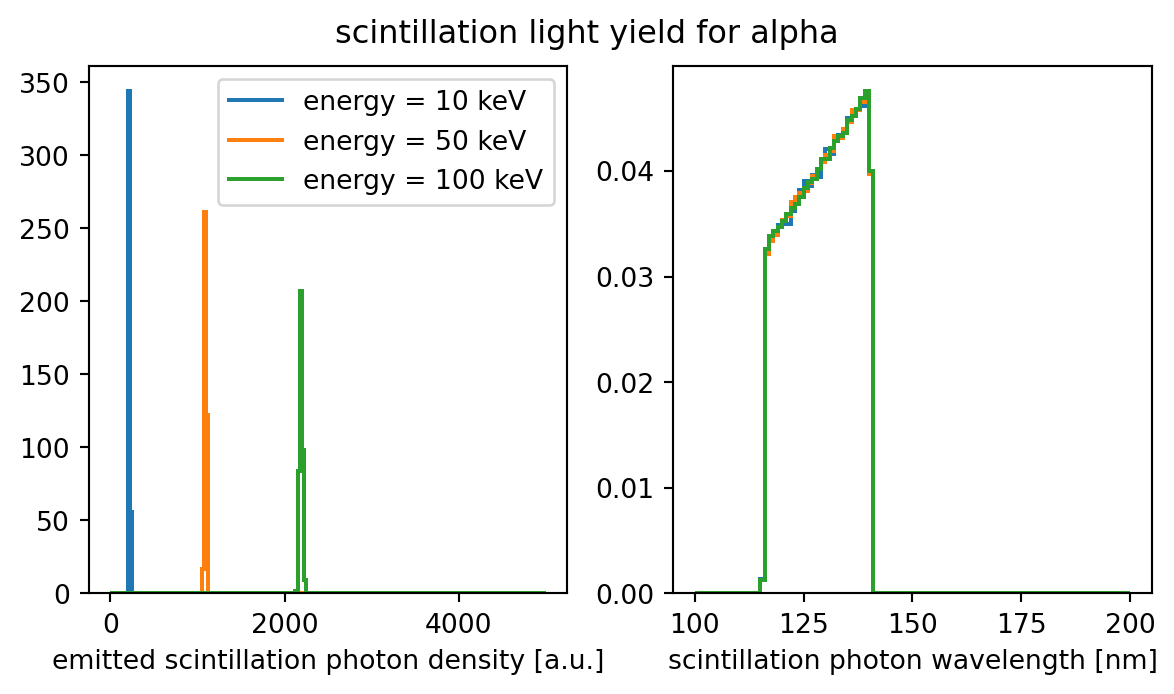
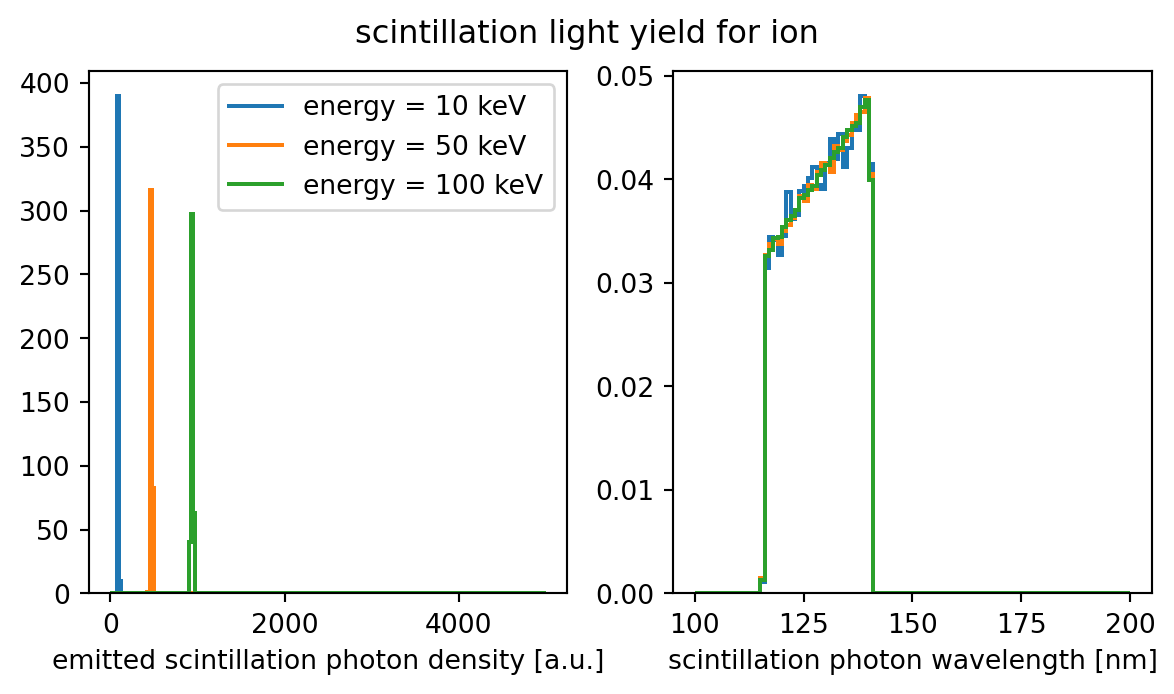
Light output for various particles and kinetic energies.
The light output for each particle forms a linear function. In the Geant4 simulation, the scintillation yield is implemented with a particle-type dependent linear function. The expectation is also shown in the plot.
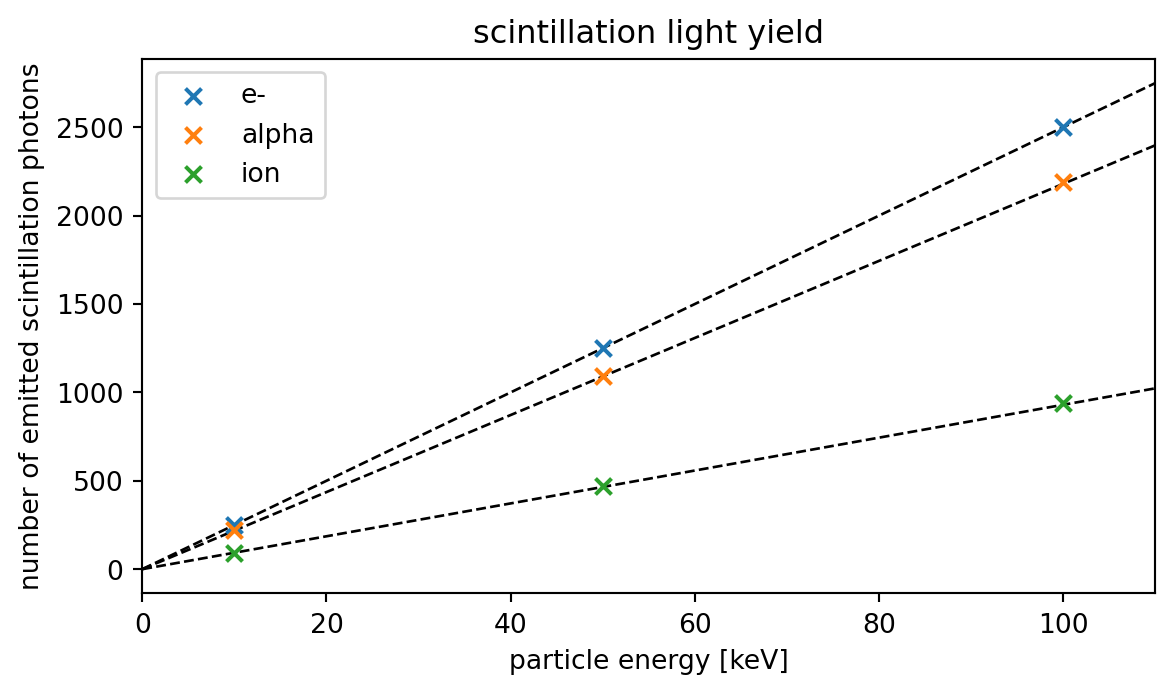
The light output for each particle forms a linear function.
Cerenkov emission
Electrons of varying kinetic energies are started in the center of a sphere of water. Optical photon attenuation is disabled. Scintillation emission is disabled. The number and energy of the created photons is recorded.
The emitted photon spectrum is equal for all electron energies after normalization to the total number of emitted photons, and not mono-energetic (as expected).
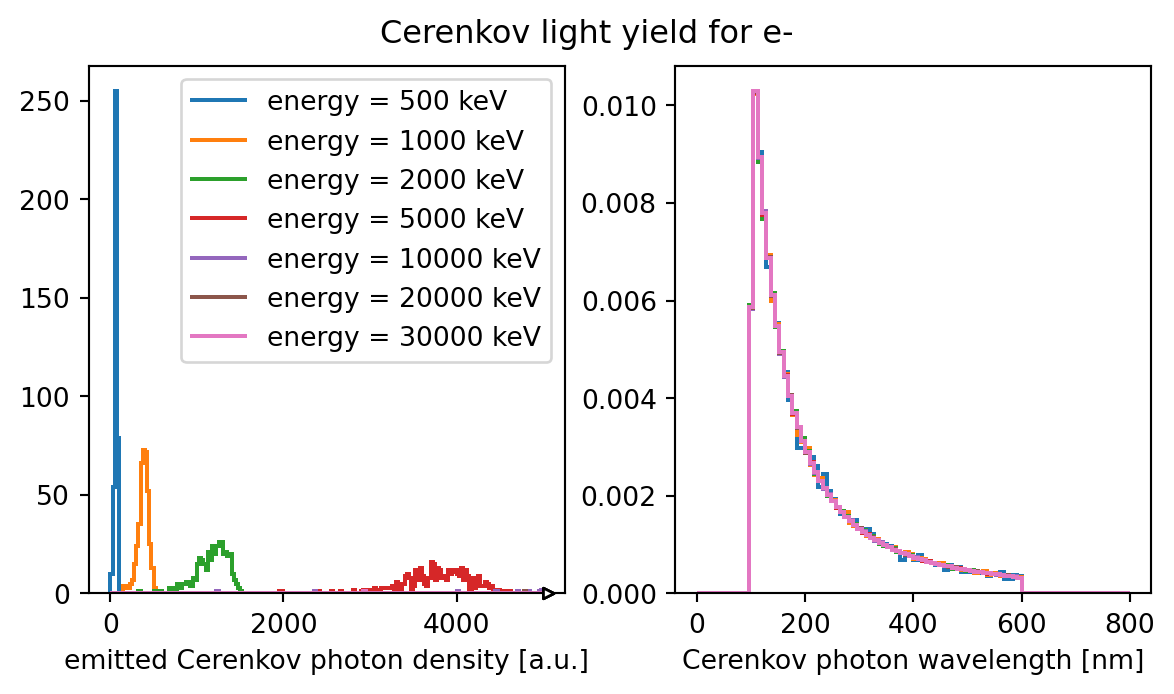
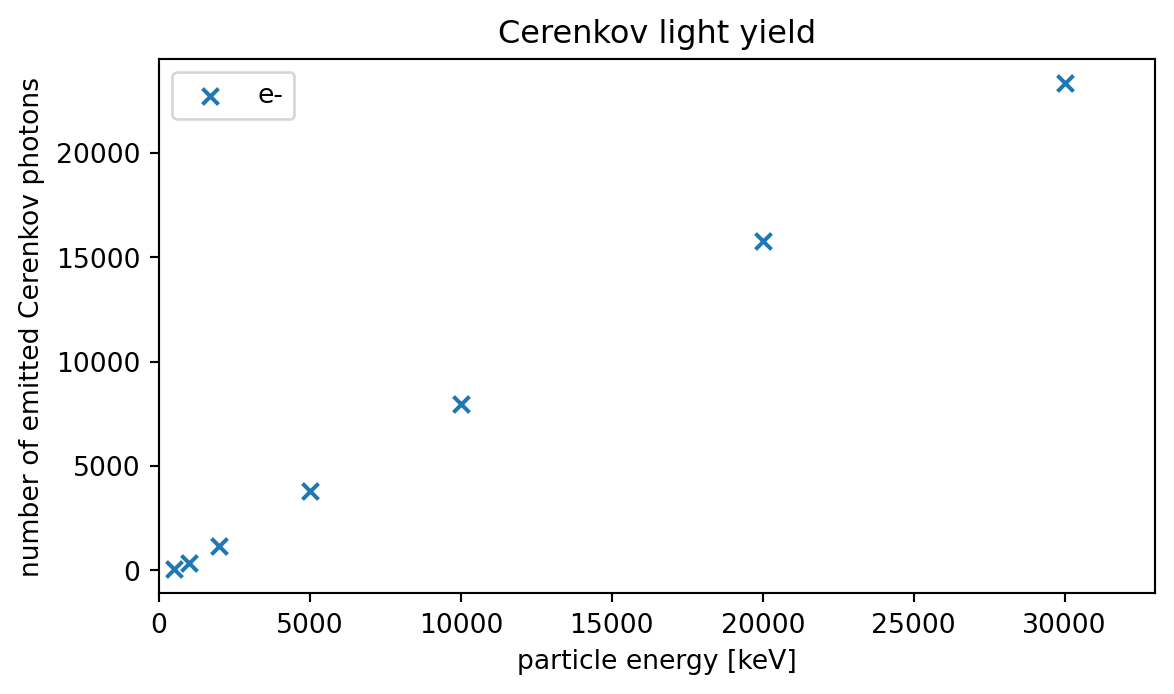
Cerenkov light output for electrons of varying kinetic energies in water.
Important
The energy range of emitted Cerenkov photons is limited to the range of the
RINDEX optical property of the material!
Light detection (surface physics)
This validation test checks the behaviour at a surface that should detect photons. The setup is as following:
a registered sensitive volume in a sphere of liquid argon.
an optical surface around that volume, with constant material properties
EFFICIENCYandREFLECTIVITY.only the liquid argon has a refractive index set, no other (attenuating) material properties.
Monoenergetic optical photons are started above the detecting surface and the number of detected hits is recorded. Between the different runs, the values of the surfaces efficiency and reflectivity are changed.
It is expected, that the total number of detected photons is proportional to the
detection EFFICIENCY and also proportional to 1 - REFLECTIVITY:
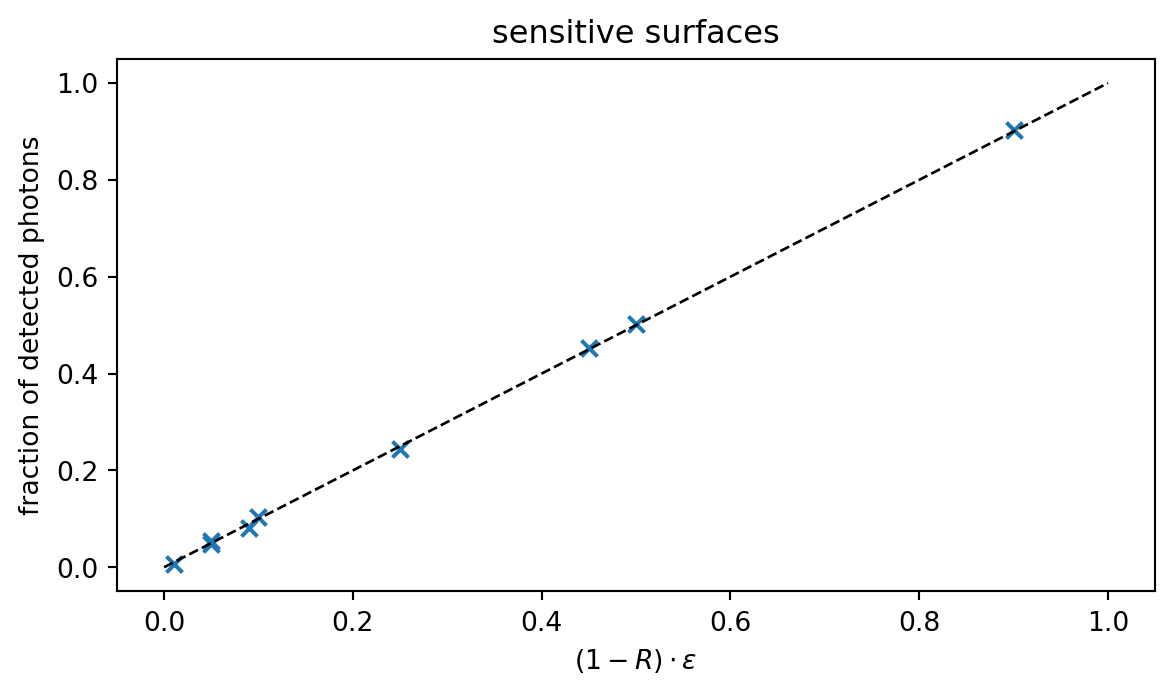
Detected light at a surface with efficiency and reflectivity
Attenuation (Absorption & Rayleigh scattering)
This validation test checks the behaviour of the attenuating processes
implemented in Geant4. These processes include bulk absorption through the
ABSLENGTH material property and Rayleigh scattering through the RAYLEIGH
property. The total attenuation is observed as the combination of both processes
that each have an exponential profile.
The geometry consists of a registered sensitive volume at one end of a tube of liquid argon (with 100% efficiency and 0% reflectivity). Optical photons are started in various distances in from of the detector plane, perpendicular to the detetcor plane.
For each length \(l \in {30\mathrm{ cm}, 60\mathrm{ cm}}\), three different sets of optical properties are simulated:
setting only an absorption length of \(l\) and no Rayleigh scattering,
setting only a Rayleigh scattering length of \(l\) and no bulk absorption, and
setting both, so that \(1/l = 1/\lambda_{abs} + 1/\lambda_{rayl}\) is fulfilled.
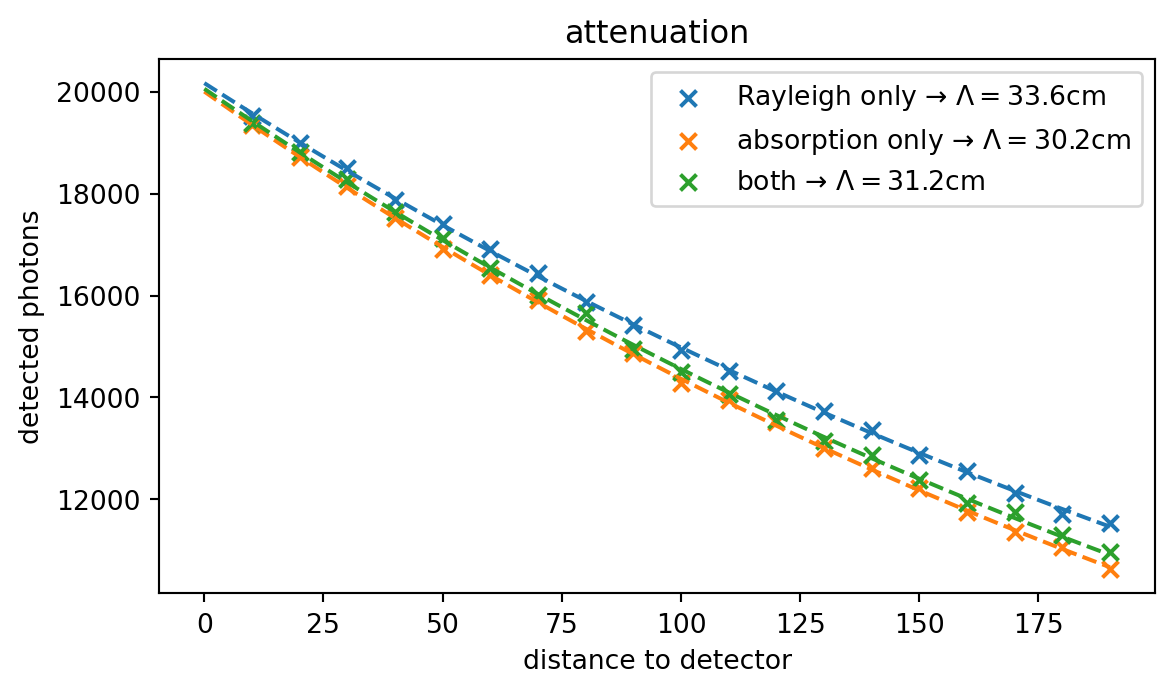
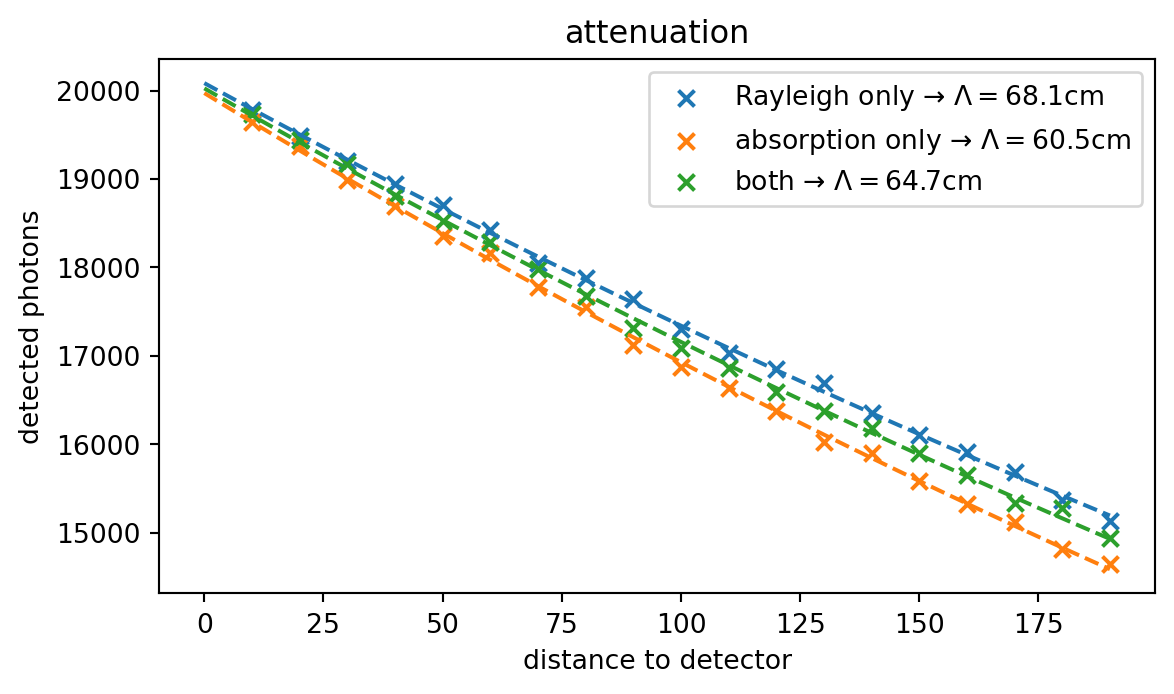
Attenuation behaviour in liquid argon with simulated points and fitted exponential attenuation curves.
The absorption-only variant shows a clean fit of the expected attenuation length. In this simple case (without scattering), the absorption is fully linear. For the Rayleigh-only case, the fitted attenuation length is larger. This should be an effect of the finite aperture of the detector. Some forward-scattered photons will still reach the detecting surface, despite being scattered. The mixed case shows a behaviour in between the two cases.
Wavelenth-shifting (WLS)
The simulation setup contains a volume of liquid argon as optical medium. The attenuating properties of the liquid argon have been removed, and a thin disk of a wavelength-shifting material is introduced between emission point and detector. The WLS emission is isotropic, so the detector is a sphereical surface that contains the shifting disk and a small opening for the incoming light, to also be able to detect back-scattered shifted light.
To reduce the effect of the border interfaces to the WLS disk, the disk has the same refractive index as the LAr. It is also not a known material from LEGEND, to simplify the calculation of the expectation values[2]. It has a WLS absorption length of 2 mm and a broad emission between around 200 and 300 nm.
The simulation is repeated with varying thickness of the WLS disk. VUV photons of 128 nm wavelength are started; the detector records the photons with their wavelength, and also their arrival times.
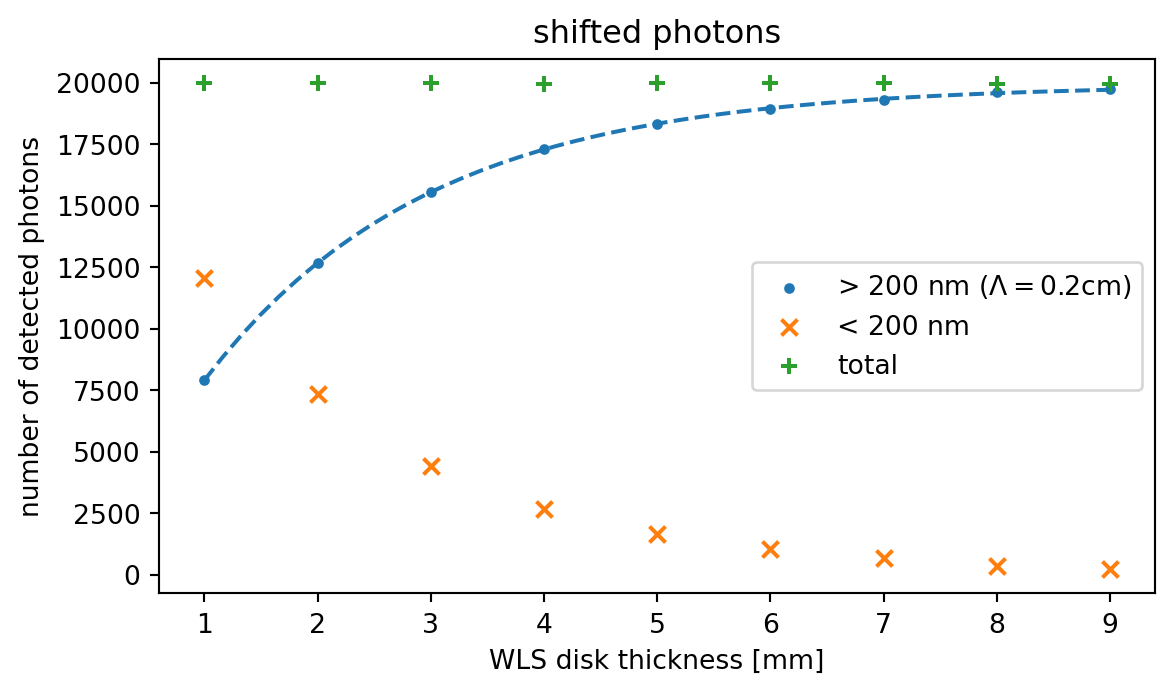
Detected light after transmission through a WLS disk.
With increasing thickness of the WLS disk, the fraction of shifted light increases exponentially, and the fraction of transmitted VUV light decreases.
Time profiles of wavelength shifting
Geant4 offers two modes how the WLS time profiles are generated. remage’s
default mode,exponential, will sample from the exponential emission time
distribution characterized by the WLS time constant. Upstream Geant4’s default,
delta, assumes a delta-function as time distribution.
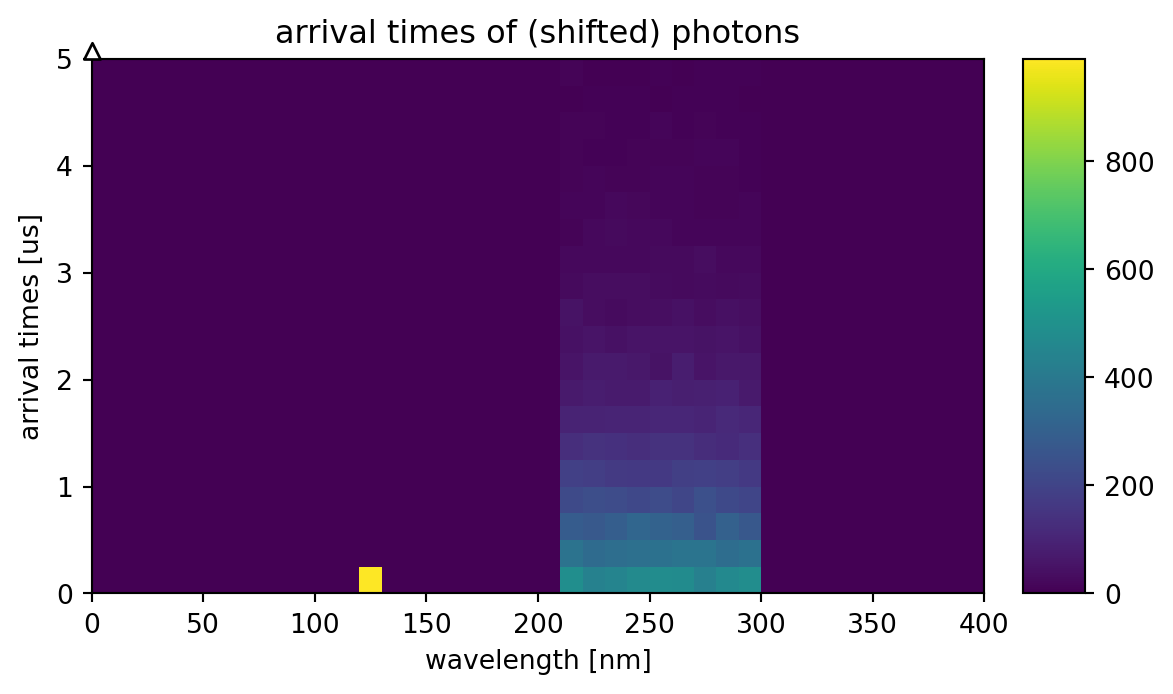
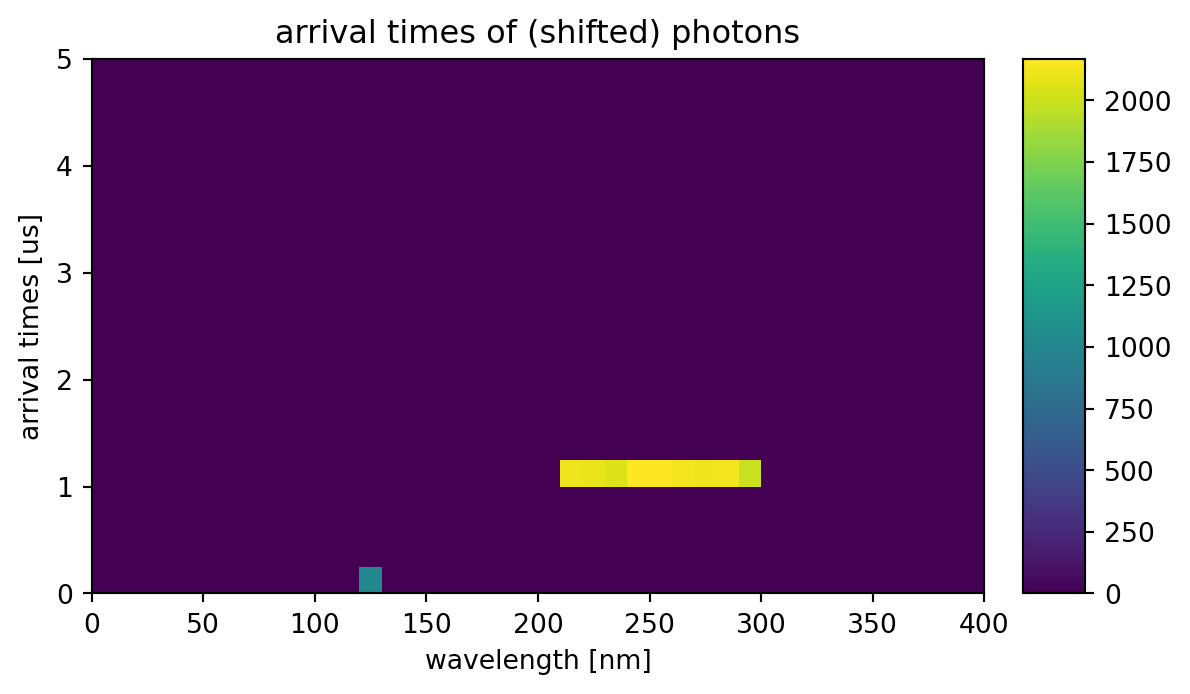
Recorded photon arrival times after WLS.
Number of emitted WLS photons
The number of emitted photons can be influenced with the scalar material
property WLSMEANNUMBERPHOTONS. remage implements a custom WLS process to
limit the number of emitted photons to 1, instead of lsampling from a Poisson
distribution as in stock Geant4. The effect of this process can be seen here:
With RMGOpWLS, this limit is enforced, whereas with OpWLS, it is not.
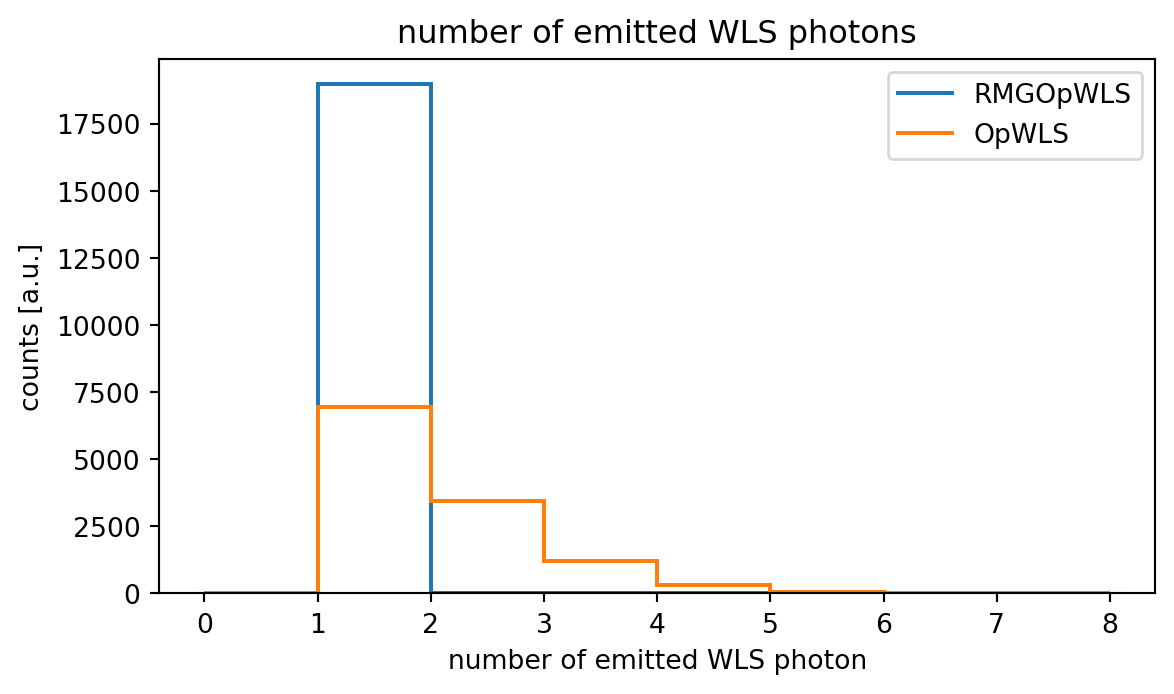
Number of emitted photons from the {RMG,}OpWLS processes.
Note
Simulation and analysis scripts are available in
tests/optics.