Internal Bremsstrahlung in Ar-39 decay
This section validates the simulation of Internal Bremsstrahlung (IB) radiation in beta decay processes, specifically for Ar-39 which is a relevant background source in liquid argon-based rare event searches.
Validation test
We simulate Ar-39 decays in a liquid argon environment with an HPGe detector and compare simulations with and without IB enabled in Geant4. This allows us to quantify the impact of IB on detector observables.
Important
In these plots, the probability to generate inner bremsstrahlung has been biased by a factor of 10 to make effects better visible even with a lower number of simulated events.
IB gamma vertex energy spectrum
First, we extract the energy spectrum of photons emitted directly from Ar-39 decays (i.e., the IB photons themselves). This is done by selecting photons whose parent track is an Ar-39 nucleus.
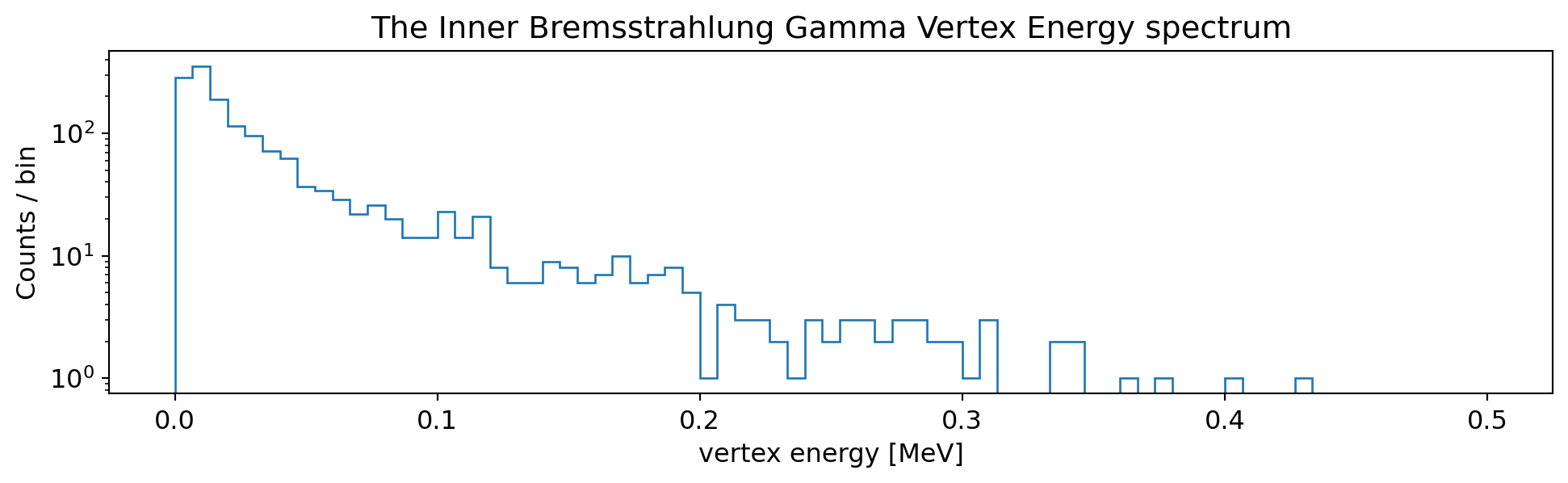
Energy spectrum of Internal Bremsstrahlung photons from Ar-39 decay. The spectrum shows the characteristic soft photon distribution, with most photons having energies below 0.5 MeV.
The spectrum shows the expected behavior: a continuous distribution dominated by low-energy photons, with the rate decreasing at higher energies. This matches theoretical predictions for IB emission.
Detector signal comparison
Next, we compare the energy deposited in the HPGe detector for simulations with and without IB enabled. This demonstrates the observable effect of IB on detector response.
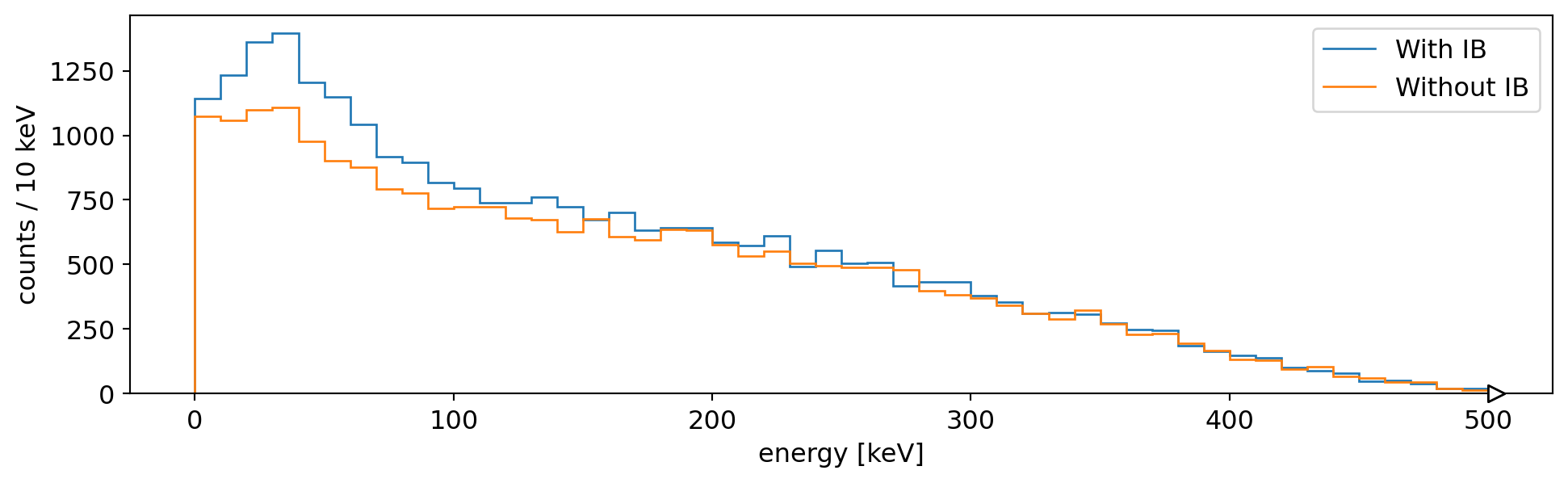
Comparison of energy deposited in the HPGe detector for Ar-39 decays with and without Internal Bremsstrahlung. The spectra are rebinned to 20 keV bins for clarity.
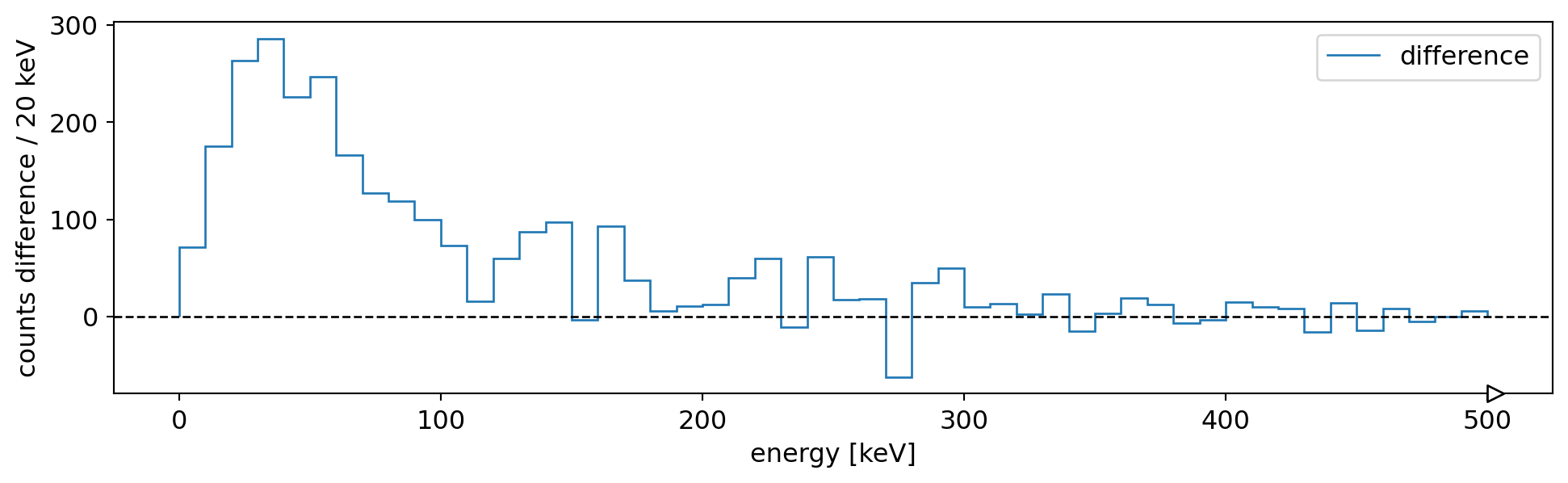
Difference in detector energy spectra (With IB - Without IB). The positive values at low energies indicate additional events from IB photon interactions in the detector.
The difference plot shows that including IB increases the number of low-energy events in the detector. This is expected as the soft IB photons deposit additional energy when they interact with the detector material. The effect is most pronounced below ~100 keV, consistent with the IB photon energy spectrum.
These validation plots confirm that:
IB photons are being generated with the correct energy distribution
The detector response correctly accounts for IB contributions
The magnitude of the effect is consistent with the \(\sim10^{-3}\) branching ratio
For precision background modeling in low-background experiments, it is important to enable IB in the simulation to accurately predict the detector response near the analysis threshold.
Reference
The spectrum is calculated based on Hayen et al., Rev. Mod. Phys. 90, 015008 (2018). https://journals.aps.org/rmp/abstract/10.1103/RevModPhys.90.015008 The calculation is described in detail in Section V Radiative Correction.